

Resident evil
on my various pursuits of weightlessness
this post was made possible by my paid subscribers. to get access the full internet princess archive and support more work like this, consider upgrading your subscription today. <3
1. ONLY NATURAL TO DREAM
One morning in the park I walk past a young couple lying on their backs in the grass, a new baby nestled between them. The mother has her eyes closed and is smiling slightly, beatific in sunlight, maybe half-asleep, and the father is facing the baby and plunging his hand up and down to tickle its bare stomach, making whirring noises with his mouth on each ascent, and the baby is laughing like something that just learned how to laugh, and the father’s face is wide open and beaming, seriously beaming, like there’s light shining out from literally inside him onto this perfect baby that’s brand new in the world, and the baby is beaming light onto him too, this great redemptive light, like I can’t imagine who he was before this, I can’t imagine him having ever done anything bad, and I realize then that I have stopped walking and am standing still just staring down at them, and maybe I have been doing this for as long as two minutes, and then I realize that I am crying.
It’s so weird, I text my friend, presumptively, to watch a stranger have what will obviously be one of the singular most beautiful moments of their entire life. I love the city for this, most of the time, for its vast de-privatization of sentiment — I like bearing witness to the best and worst of other people, and I like the knowledge that I am witnessed in return. Vivian Gornick writes that walking the streets allows her to extract the flash of experience again and again… from the endless stream of event: she is able to sort chaos into meaning through participation in the public theatre of strangers. The street does for me what I cannot do for myself, she writes. I feel the same. But sometimes they feel too fierce, these attachments. I walked past a couple getting married in Washington Square Park the other day, and they kissed in the clearing just west of the fountain with their arms wrapped so tight around each other, and everyone was cheering and throwing flower petals, just this completely brutally perfect moment, the sun shining through the English elms, the college students dotting the lawn behind them like confetti, and as they pulled away I made three long seconds of uninterrupted eye contact with the groom. There was nothing wrong with it, nothing improper, but I walked around for an hour afterwards with a strange pit in my stomach, picking the skin off my cuticles, feeling dirty.
I have to realize the street gives me back a primitive reflection of whatever load of hope or fear I am carrying about with me that day, Gornick continues, making me wonder about what loads I might be carrying. I guess I don’t know what’s beautiful to anyone else, anyway — I don’t know if that young dad with his perfect baby will ever think about that day in the park again, much less think about it as often as I have. I barely know what’s beautiful to myself. I’ve started to realize that I wake up each morning in a perpetual emotional present, all the moments of real happiness or sadness or loneliness or madness of the previous day blurry and inert, like a story I’ve heard secondhand from someone I don’t care about. Reading my journal from the day before always feels like reading the ramblings of a total psychopath, getting so worked up over nothing, these daily fits of exaggerated joy and melancholy, this contrived wonderment, the lungs must just ache from their perpetual gasping, Christ; but then I of course descend back into those same hysterics as the day expresses its theatre upon me, and then the slate is somehow wiped clean and I’m teed up to feel it all for the first time over again. I’m tired of all this novelty, of always having to be broken in anew. I’ve been thinking about that Ralph Waldo Emerson line so much, recently: Our moods do not believe in each other.
2. I’VE BEEN HAVING SOME BAD ONES
I’ve been having this recurring nightmare in which I get sexually assaulted by someone I know. The aggressor is a different person each dream, like James Bond or Doctor Who (who will be next in line to put their spin on the iconic role, one wonders!!) but each time the assault is the same, vaguely similar in its broad strokes to a specific violation I experienced in real life. Each time I feel sexual desire for the person before the assault happens, and each time the worst part of the dream is a period of drawn-out anxiety after the assault about whether or not I wanted it, manifested it for myself, deserved it due to the immoral glut of my desire, and also about whether the sex I almost-wanted constitutes an act of infidelity towards my boyfriend, who is my boyfriend not only in this dream but in real life as well (brag). Also pretty regularly, although usually on a different night, I have a vivid dream in which I give birth to a baby and care for it in its earliest days of life. It plays out in real time — sometimes it feels like I’m living for weeks, waking up in the morning and making breakfast and running errands and breastfeeding and falling asleep, all the while feeling this real, new love, different in shape than any love I’ve ever felt in the real world — and then I wake up and it all evaporates, this whole life gone. I was holding her in my arms, I could smell her soft head.
The most obvious interpretation of the latter dream, to me, is that I have spent the past few months in the most intense throes of writing my book, and it is the hardest I’ve ever worked on anything, and I have started to see for the first time with clarity the shape that the book might actually take when it is finished; this process has terrified and overwhelmed and exhausted me, and most of all has forced me to face at once both the vast scope of my ambitions and the profound limits of my abilities. My amateur dream analysis would not be the first time a women’s artistic work has been analogized to childbirth, and I have reluctantly begun to understand why this metaphor persists — it does feel like I’m forcing something out of me and into the world, pushing until I tear. As for the assault dream, I’ve begun to interpret it as (among other things, of course) a vague representation of various social anxieties towards each of the different people who appear as pseudo-aggressor. What does it mean, I wonder, for birth to be my primary unconscious unit of creation, and sexual violence to seemingly be my primary analogue for conflict? I spend all this time trying desperately not to think about my body but it hunts me like a dog.
I’m tired of all this woman stuff. I don’t want to think so much about it, I want so badly sometimes to be able to write about something else. I wish I still remembered how to do math. For my whole life up until a few years ago I thought I’d be a physicist, and no one even knows that about me anymore. I remember a mentor in the math department saying to me once, bitterly, sadly — if you work in math, every day of your life will be about being a woman. If math is the only thing you can possibly do with your life, then it’s worth it; if you could be happy doing literally anything else, you should get out. And so I listened to her, and I left, and then somehow wriggled my way into this TRULY WONDERFUL career that makes me feel ALIVE and FULL OF PURPOSE in a way I never could have imagined, and where every single day of my working life is nevertheless about being a woman anyway.
Like any good woman should, I feel uncomfortable with my own instinctive skepticism on the matter (we have all seen the Barbie movie, of course, and so all know by now that girl stuff is nothing to be ashamed of and femininity is an awesome gift!!!!). It’s become a kind of cultural dogma that any resistance to one’s own girlishness must be symptomatic of a deep internalized misogyny — and this idea is often subtly accompanied by the tricky rhetorical trad-ism that girls aren’t worse, just different, and that it shouldn’t be a problem to say so unless you think girl stuff is bad. And listen: I know that patriarchy is responsible for the idea that it is stupid or vapid to make “women’s work” or to care about “women’s issues”. And yet I can’t help but notice that it is also patriarchy, presumably, that has created the social conditions for women to land so frequently within the bounds of “women’s work” and “women’s issues” (unless you believe that women are biologically disinclined to be engineers, which I, boldly, do not). How do you criticize the latter condition as undesirable without re-entrenching the idea, for lack of a more elegant phrase, that “girl stuff” is bad, that it is offensive to be associated with it? All I know is that I want to be wary of defining the air as male and bravely refusing to breathe, as Andrea Long Chu says. All attachments should be interrogated, including my attachment to this identity, to my own unassailable victimhood. I laugh out loud re-reading the first line in the introduction to The Second Sex: I hesitated a long time before writing a book on woman. The subject is irritating, especially for women; and it is not new.
There’s a part in the beautiful and formidable book Committed where Suzanne Scanlon reflects on an elderly woman in her writing workshop, a lifelong anorexic, who writes about grieving the life she could have had if she hadn’t spent so much of it thinking about her weight. The woman looks back at her diaries while trying to write a piece for the group, decades of pages full of carefully-logged calories and I feel fat, I ate today and I feel fat in her own handwriting again and again, and is humiliated, most of all, by the banality of this obsession — by the plain cliche of looking back and seeing so clearly that her weight and her body were her life’s greatest passions, her most dedicated field of study. She talks about her late husband, who was passionate about Shakespeare and Erasmus, who had built an encyclopedic breadth of knowledge about 16th century literature. What could she have been passionate about if she hadn’t been so preoccupied with the weight of her body, she wonders? Could she be writing about Shakespeare, now?
Scanlon takes an empathetic approach, thoughtfully and rightfully — she avoids didacticism or condemnation, choosing instead to explore the conditions that affect our engagement with bodily art and bodies in general. The chapter ends on this line, quoted from a fellow student in the class: We don’t get to choose our obsessions, and really, who says that thinking about Shakespeare or botany or quantum physics is more valuable than thinking about what it means to live in a body.
When I first read this passage, I started to cry in the park, confused and strangely angry, validated and unsatisfied at once. I of course have made that same argument to myself countless times, and have begged myself to believe it, and have each time been left more uncertain than when I started. Here’s what I know: I am not ashamed to write about women, certainly; I don’t think my life would have been better spent as a physicist, not at all. It is inarguably true that there is nothing intellectually or artistically inferior about exploring the body and the self (and truer still that men write about their bodies and themselves all the time, but they often get to pretend they’re writing about something else when they do and are generally taken at their word — whereas a woman could publish a geological survey of a volcano site and it would be read as a metaphor for her hole). I understand, too, the need to defend the historically-maligned field of “women’s writing” from accusations of frivolity, navel-gazing, self-obsession (trust me, I do!). But I can’t help but be frustrated at what feels like this twee simplification of the matter at hand, as if writing or thinking about your body as a woman is just another thing you can do, an “obsession” as morally neutral and freely available as any other, and as if the only possible factor problematizing one’s engagement with that obsession is that it’s not seen as respectable enough by masculine society. This isn’t satisfying to me, somehow.
Most confusing of all is that fact that I am so genuinely glad to read, even secondhand, this woman’s writing about her lifelong struggle with and for her body; it is precisely that type of writing that I’m in fact most interested in reading, a type of writing that has both enriched my life and literally saved it over and over again. If she had lived a life that drew her to write about Erasmus, I would have never encountered her work nor cared to read it, and so perhaps it’s silly — if not patronizing — to say that I wish that life for her nonetheless. But I do. I wish she’d gotten to live it. I wish all those pages in her journals could have been full of something else.
A few days after I read this passage for the first time, I went on a walk in Central Park with a friend who has also spent periods of his life being troubled and sad and unwell, who has felt real pain and shouldered great, vast questions about what it means to live in a body, but who has largely dedicated his mind in spite of it all to the daily pursuit of his passions for mathematics, history, and literature. I tried to ask him what he thought was the difference between us — why, even though we both got these bad hands, these bad brains, he got to study proofs and manuscripts while I’d spent every day we’d known each other circling the drain of my own illness, my physical form, my gender. Why does he get to reach outwards into the world in all directions, while I’m stuck with the supposed gift of thinking about what it means to live in my body? I don’t want this privilege; I didn’t ask for it. (I imagine a joke, delivered Seinfeld-esque: Hold on, you’re telling me I have to think about my body all the time? I don’t even LIKE my body! Laugh track, laugh track.) I said, sometimes I think I’m just more interested in my own dysfunction than you are. And he sort of smiled and said, yeah, I think that might be true.
I only realized after I dropped out of school that while I honestly did like physics — I actually even loved it, sometimes — I think some part of my attraction to the field was a fantasy I’d cooked up in the anxious anticipatory muck of pre-puberty that if I could get smart enough, smart enough in the right way, then I might be able to escape the functional category of girl. Or, perhaps more accurately, my fantasy was that I could dominate it, instead of being the one dominated — that my impending womanhood could be a trick I pulled instead of a trick that got pulled on me. (My pubescent breasts were inflating in front of my eyes like God’s whoopee cushion, a setup stretching out in front of me towards an unforeseen but guaranteed punchline.) Maybe it’s only embarrassing to be a girl, I thought, if you’re stupid — if you confirm the stereotype instead of subvert it. And maybe it’s only boring to be smart if you’re a boy (or, I might have thought privately, in the worst recesses of my mind, ugly).1 I once asked a physics teacher if he thought I was good enough to get into a doctorate program one day, and he said, I mean, come on, no matter what, they’ll be throwing money at you like a stripper on a pole. And then he paused and said: please don’t tell anyone I said that.
It’s hard to write about stuff like that without sounding like I was offended by it, because really I wasn’t. I could produce a laundry list of those banal academic misogynies, most of them way worse than that one and also less funny, many of them meaning almost nothing to me. Well, that’s not quite right: they were often painful, and certainly humiliating, but it wasn’t as if misogyny scandalized or shocked me even when it hurt me. In the case of that teacher, it was mostly just fascinating, at the very least on a structural level: the tacit acknowledgement of my gender and its historical powerlessness (come on, no matter what) next to a tacit acknowledgement of the relative privileges that might be heaped upon me as reward for overcoming that powerlessness (they’ll be throwing money at you), juxtaposed against a vague re-entrenchment of the power structures at hand (like a stripper on a pole), all bookended with a tacit acknowledgement of a new, special type of power I might glean from bearing witness to an older man’s bungling of these power dynamics (please don’t tell anyone I said that). I remember walking out of that interaction feeling like I was holding a little secret in my hands, like I’d dug something valuable and dangerous out of the dirt. I think, too, it may have just felt good to have something to complain about that wasn’t the math itself.
And I don’t think I really did drop out because I was a woman, or even because school was too hard, because I couldn’t hack it2 — I think I just dropped out because I wanted to kill myself, which was maybe a little bit because of the woman stuff but also surely because of a complex web of factors I can still neither understand nor satisfyingly quantify. There it is again: that matrix of ancient human suffering that persistently defies my attempts to categorize it. There it is again: the allure of easy cultural criticism, promising to smooth down those agonies into a comprehensible and vaguely cathartic shape.
I actually don’t even write about my body very much, which is on purpose. The subject is irritating, especially for women; and it is not new. I’ve never written a body image essay, I’ve never included in my long self-indulgent descriptions of my own self-hatred the thoughts about wanting to be smaller, I’ve never really even posted a joke about it on Twitter. I think it is generally irresponsible to tweet glibly about your desire to be emaciated, and I do actually think it’s embarrassing for adult women to do, and anyway I feel pretty okay about my body these days, ultimately. And still. The other day I was reading a difficult, exhilarating book and working through a series of ideas that physically excited me, that made me feel like I had access to more actual life than I did before, that filled me up with a tangible sense of purpose and belonging in the world, and I nevertheless could feel, all the while, the cool imposition of this one thought, again and again, pressing itself against the back of my skull: I wish clothing would just hang off of me, I wish it would just hang. There, that’s it, no more.
3. AND I GOTTA KNOW WHAT THEY MEAN
On the morning of my 24th birthday Sadie makes me whipped cream by hand and we listen to Tom Waits in the kitchen and I think that I could live like this forever, really, this could be my life forever and I wouldn’t complain. I know that I felt this way because I wrote it down, right there, in this document — I left the kitchen as it was happening to write that down, maybe not just for myself but also so that someone else could see it. There it is, right in front of you: one of the happiest moments of my entire life.
My dreams got better when Sadie was there. I tried to start recording them recently, in the hopes I could glean some insight about myself or the world or something, but I had to stop: it began to feel almost immediately like I was imposing my conscious mind somewhere it didn’t belong, trying too hard to know too much. I felt lucky to forget my dream this morning. Some part of myself has been permitted to escape interpretation, to outrun its own weight.
I wonder when I’m going to know something for real, really know it, so that I don’t have to be taught it again. Gornick, in her own essay about women and work: Everything I have just written: I have lost sight of times without number… If you don’t take in experience there is no change. Without change the connection within oneself dies. As that is unbearable, life is an endlessness of “remembering” what I already know. So where does that leave me? In perpetual struggle.
My moods do not believe in each other. I forget it all.
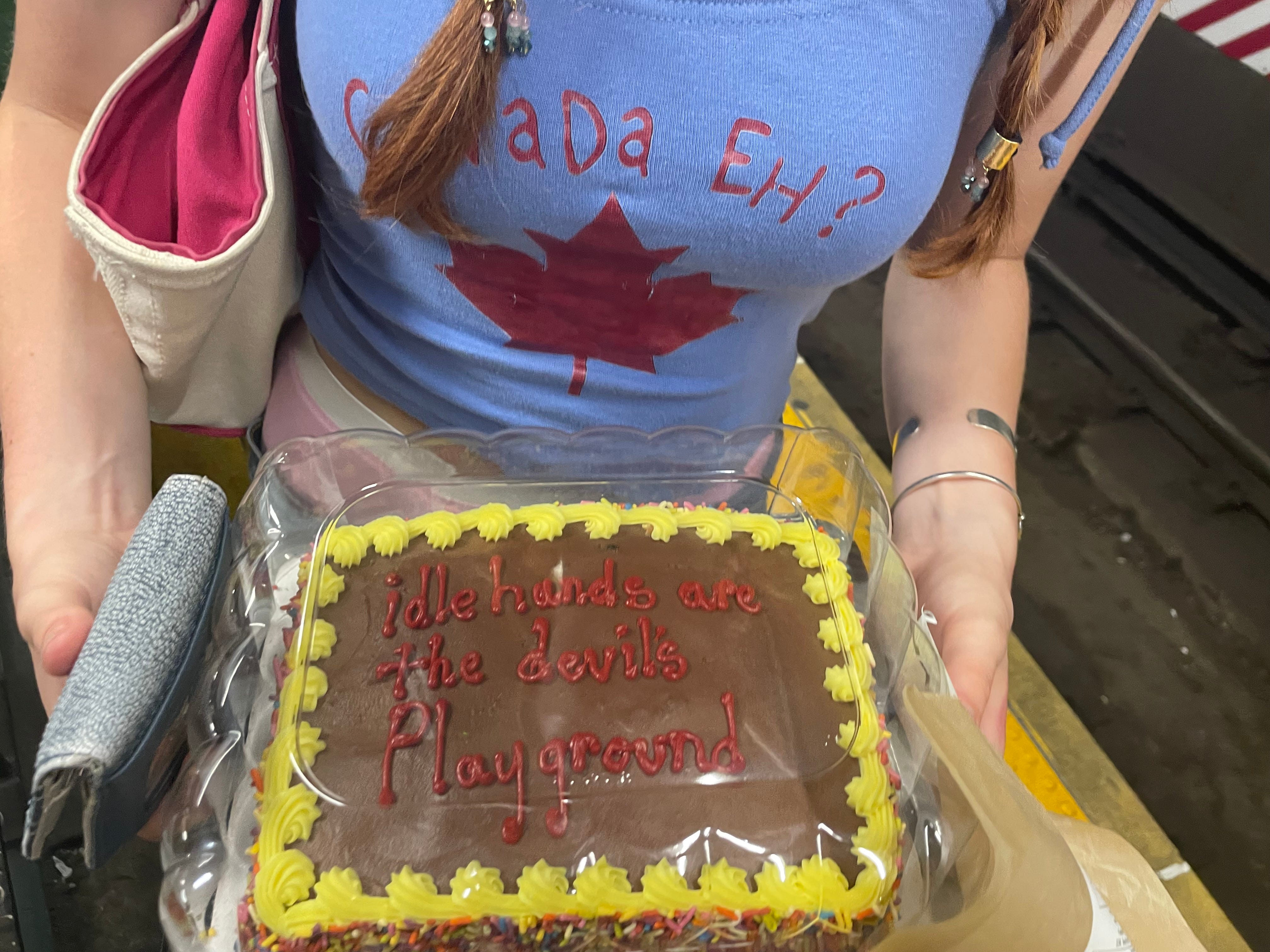
thank you for reading this weird compulsive diary entry... here’s my summer playlist…. if you want to get a sense of what i’ve been on recently, put on i am a cinematographer by palace brothers and then immediately listen to c’mon by kesha and repeat again and again until you get dizzy.
xx rayne
p.s. i’m randomly in austin texas by myself for a month. do you know anything weird or interesting to do here? please let me know if so. <3
this thought, while evil and insane, has of course only been culturally validated in recent years by the emergence of t-shirts that say Hot Girl Math and Brain Slut and Good Book Pussy (?) and so on
I actually got PRETTY GOOD GRADES not that it matters of course
Thank you for writing this. Jesus Christ. Thank you.
I’m a senior in college now, studying English and math. I’m eight years into recovering from an eating disorder, into not thinking about it. There is so much life to live. There is so much math to do and so many books to read. I know a lot of things; I can do a lot of things; I think, if I chose something, if I really put my mind to it, I could do anything at all. I go to my Measure Theory class and there are three women, and one of them is our professor (who I can’t talk to without wanting to cry — I’m writing my thesis with her and it’s a battle every week to sit in her office and talk to her about complex, difficult mathematical issues without bursting into tears thinking about how hard she has worked to get to where she is, and aren’t I sick of that desire? How patronizing those tears would be). But I sit in the classroom and sometimes I find myself wishing my body was made of marble instead of listening to her speak. While I’m working on problem sets I get up and walk around my room, setting my camera up at different angles, trying to trick my body into looking like nothing but clean white bone. And people ask me what I write about and I don’t have a good answer — I write all the time, all I do is write and write, and everything I say comes back to the wish that I could peel off my skin and be nothing but sharp angles. I read feminist theory and I believe it and I think about the subjugation of women and I place myself and my own thoughts within this long history of oppression and I continue doing math because I love it and I talk loudly and I don’t hold my tongue for the sake of the men I sleep with and I talk about queer theory over brunch and I read and think and write and write and write and everything, it seems, comes down to my body and its relationship to me. I am powerless in the face of it. I need to write it down or I will not be able to get around it. But that’s just the thing: I have been writing it down, and I haven’t gotten around it. I am pinned underneath it. Trapped, by the weight of my own desires, the weakness of my body to resist.
“my impending
womanhood could be a trick I pulled instead of a trick that got pulled on me” thank you rayne